
enviar correo electrónico info@xinhuatextile.com
¿Necesitas ayuda?+86 -13805995216
enviar correo electrónico info@xinhuatextile.com
¿Necesitas ayuda?+86 -13805995216

A Guide to Selecting Materials for Non-Woven Shopping Bags: Choosing the Right Fabric for Totes, Drawstring Bags, and Promotional Bags
Non-woven bags serve as a mainstream eco-friendly alternative to plastic bags, widely used in retail, trade shows, gifting, and promotional campaigns. However, procurement professionals often fall into common traps: prioritizing the lowest price—which leads to poor load-bearing capacity and a tendency to tear—or opting for unnecessarily high fabric weights, resulting in wasted costs. Others may overlook printability, leading to blurry or fading designs on the finished product, which can negatively impact brand image.
As a primary manufacturer of non-woven fabrics, we draw on years of experience supplying materials for bag production to break down the selection logic for three major bag types—totes, drawstring bags, and promotional bags. We evaluate these based on four key dimensions: material and manufacturing processes, fabric weight, core performance indicators, and common pitfalls to avoid—helping you identify the most cost-effective fabric solution for your needs.
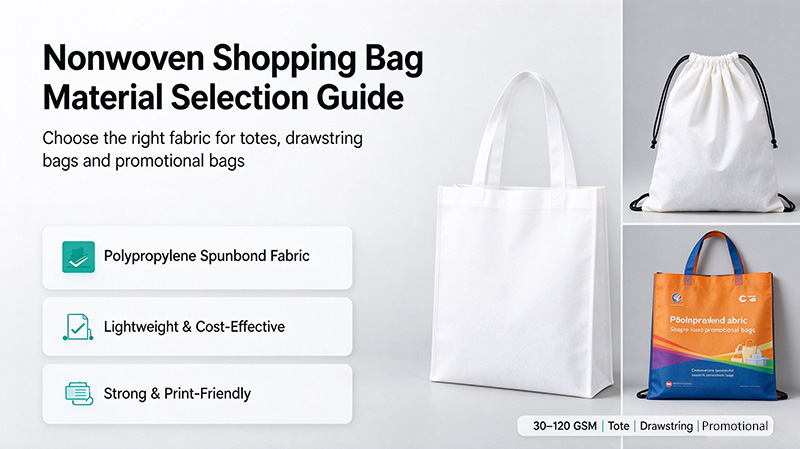
I. Non-Woven Totes: Prioritizing Load-Bearing Capacity, Structural Rigidity, and Durability
Non-woven totes are the most widely used category, encompassing supermarket shopping bags, retail bags for brands, and corporate gift bags. The primary requirements are sufficient load-bearing capacity, resistance to pulling/stretching, and the ability to maintain shape over extended use.
Recommended Materials and Processes
Top Choice: PP Spunbond Non-Woven Fabric
Featuring a continuous filament structure, this material offers high longitudinal strength, excellent wear and tear resistance, and a manageable cost, making it the industry-standard base material for non-woven bags. High-quality virgin PP spunbond fabric provides a uniform surface that ensures superior print results. It can also be enhanced through post-processing techniques—such as lamination or embossing—to improve both its tactile quality and water resistance. - Standard Version: Uses natural or colored spunbond fabric with screen-printed logos; offers the best value for money.
- Premium Version: Spunbond fabric laminated with an OPP film; waterproof, wear-resistant, and supports high-definition color printing—offering a texture similar to laminated paper bags.
- Heavy-Duty (Reinforced) Version: Features high-GSM (heavier-weight) spunbond fabric with reinforced handles, designed for carrying heavier loads.
Key Selection Criteria
1. Fabric Weight (GSM)
- Lightweight/General-Purpose: 70–80 GSM; suitable for everyday light shopping or retail packaging; load capacity: 3–5 kg.
- Standard Shopping: 80–100 GSM; ideal for supermarkets and brand retail; load capacity: 5–10 kg.
- Heavy-Duty: 100–120 GSM; suitable for gift bags or packaging for construction materials/hardware; load capacity: 10–15 kg.
2. Core Performance Metrics: Tensile strength (longitudinal), tear strength, and peel strength at the handle attachment points.
3. Pattern/Texture: "Sesame dot" or "cross-hatch" patterns provide better structural rigidity and grip; "plain" (smooth) textures are better suited for high-detail printing.
Common Pitfalls to Avoid
Do not focus solely on GSM without considering the raw material. Spunbond fabric made from recycled materials can be over 20% weaker than virgin-material fabric of the same weight, leading to issues like broken handles or torn bags. For heavy-duty bags, always choose virgin PP (polypropylene) spunbond fabric and verify that the handles are reinforced. If color printing is required, prioritize plain or fine-patterned fabric with a uniform surface to prevent the embossed texture from distorting large printed designs.
II. Non-Woven Drawstring Bags: Prioritizing Softness, Smooth Closure, and Refined Texture
Drawstring bags are commonly used for packaging footwear and apparel, storing gifts, holding trade show giveaways, or serving as dust covers. Since they rely on a drawstring for closure, the primary requirements are that the fabric remains soft, the drawstring glides smoothly, and the bag can be folded into a compact size. Recommended Materials and Manufacturing Processes
Mainstream Choice: Lightweight PP Spunbond Non-Woven Fabric
Characterized by a low basis weight, a soft hand-feel, and ease of folding for storage, this cost-effective material is ideal for mass-produced promotional items and dust covers for footwear and apparel.
- Standard Storage: Double-sided calendered (smooth-pressed) spunbond fabric—offers a sleek texture and ensures that drawstring channels are resistant to snagging.
- Premium Gift-Grade: Options include hydro-entangled (spunlace) non-woven fabric or high-density spunbond fabric, providing a more refined touch that elevates the perceived value of the product.
- Functional Variants: Can be treated with water-repellent or anti-static finishes, making them suitable for packaging electronic products and precision components.
Key Selection Criteria
1. Basis Weight (GSM) Range
- Dust Covers / Promotional Items: 40–60 GSM—lightweight and economical; suitable for single-use or light-duty storage.
- Footwear & Apparel Packaging: 60–80 GSM—offers a balanced structure, providing a quality feel while maintaining shape.
- Heavy-Duty Storage: 80–100 GSM—durable and reusable; well-suited for premium gift packaging.
2. Core Performance Indicators: Surface smoothness, resistance to snagging/fraying, and lateral (cross-directional) softness.
3. Design Detail: Drawstring openings should be reinforced to prevent tearing or splitting under tension.
Common Pitfalls to Avoid
Avoid fabrics with an excessively high basis weight or a stiff, rigid texture; these can hinder the smooth operation of the drawstring closure and result in a bulky, difficult-to-store item, negating the primary benefit of a storage bag. Materials with a rough surface or prominent thermal-bonding (embossing) points are prone to snagging, which detracts from the user experience. For footwear and apparel packaging, opt for calendered (smooth-pressed) spunbond fabric to minimize pilling and the accumulation of lint or fibers.
III. Promotional/Advertising Bags: Lightweight, High-Quality Printability, and Cost-Effective
The primary requirements for promotional, exhibition, or event-based bags are a large surface area for brand messaging, cost-efficiency, and ease of transport for the recipient. As these are intended for single-use or short-term promotional purposes, extreme long-term durability is not required. Recommended Materials and Production Techniques
Top Choice: Lightweight PP Spunbond Non-Woven Fabric
Characterized by low basis weight and a competitive unit price, this material is ideal for large-scale custom printing—a popular choice for giveaways at trade shows, promotional events, and other functions.
- Basic: 30–50 GSM thin spunbond fabric; features single-color screen-printed logos; offers exceptional value.
- Standard: 50–70 GSM spunbond fabric; provides good color saturation, suitable for multi-color printing.
- Premium: 70–80 GSM spunbond fabric with a light lamination; water-resistant, allows for high-quality printing, and is durable enough for repeated use.
Key Selection Criteria
1. Basis Weight (GSM) Range
- Giveaway/Promotional: 30–50 GSM—ultra-lightweight, cost-effective for large-volume distribution.
- Trade Show/Event: 50–70 GSM—balances quality and cost; supports a load of 2–3 kg.
- Brand Promotion: 70–80 GSM—higher quality feel, enhances brand perception.
2. Core Metrics: Printability, color opacity, and surface smoothness.
3. Production Techniques: Screen printing is the most cost-effective; heat transfer is ideal for gradients; lamination supports high-definition, full-color printing.
Common Pitfalls to Avoid
Thicker is not always better for promotional bags. Excessively heavy bags become a burden for the recipient, making them less likely to be accepted, while also significantly driving up costs. Focus instead on print clarity and color accuracy. Bags made from low-quality recycled materials often suffer from inconsistent color, poor ink adhesion, and flaking or fading—all of which can damage your brand image.
IV. Comparison Table: Key Specifications for Three Main Bag Types
| Bag Type | Recommended Material | Common GSM Range | Typical Load Capacity | Key Advantages | Typical Applications |
|---|---|---|---|---|---|
| Non-woven Tote Bag | PP Spunbond Nonwoven Fabric | 70–120 GSM | 5–15 kg | High strength, excellent load-bearing capacity, durable | Supermarket shopping, retail packaging, gift bags |
| Non-woven Drawstring Bag | Lightweight PP Spunbond / Spunlace Nonwoven | 40–100 GSM | 2–8 kg | Soft texture, easy to fold and store, drawstring closure | Shoe & garment dust protection, gift packaging, storage bags |
| Non-woven Promotional Bag | Lightweight PP Spunbond Nonwoven | 30–80 GSM | 2–5 kg | Low cost, large printing area, lightweight | Trade show giveaways, event promotions, brand marketing |
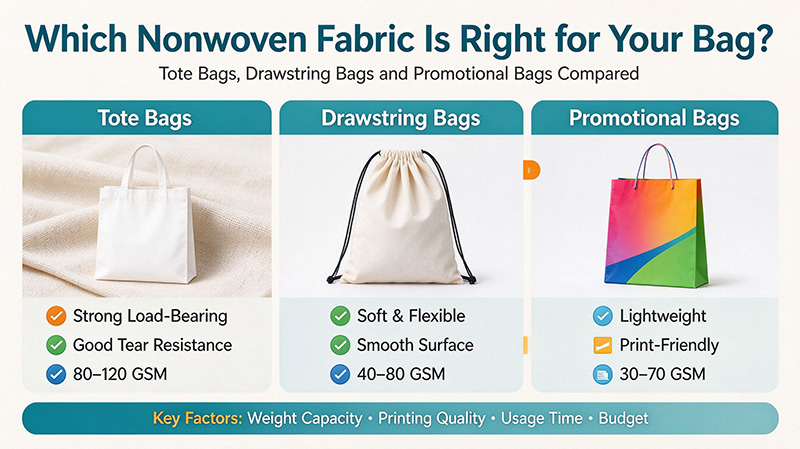
V. 5 Essential Dimensions for Material Selection
Regardless of the bag type, consider the following five dimensions to make a balanced decision:
1. Load-Bearing Requirements
Heavier loads require a higher basis weight (GSM). Additionally, verify the fabric’s longitudinal tensile strength and the reinforcement method used for the handles. Never use low-GSM fabric for heavy items, as this significantly increases the risk of handles snapping or the bottom of the bag splitting. 2. Printing Requirements
- Simple, single-color logos: Standard spunbond non-woven fabric with screen printing is the most cost-effective option.
- Multi-color or gradient designs: Opt for non-woven fabric with a smooth, finely embossed surface, or consider lamination.
- High-definition, full-color, or photographic-quality prints: Laminated non-woven fabric is the best choice for superior print results.
3. Usage Cycle
- Single-use or short-term distribution: Choose a lower basis weight (gsm) to keep costs down.
- Reusable or long-term use: Select spunbond fabric made from virgin (non-recycled) material with a basis weight of 80 GSM or higher for increased durability.
4. Budget and Costs
Every 10 GSM increase in basis weight raises material costs by approximately 8%–12%. Lamination and specialized post-processing will further increase costs. To optimize, select the lowest feasible basis weight that still meets your requirements for load-bearing capacity and texture.
5. Environmental Standards and Compliance
For exports to European and American markets, ensure compliance with REACH and RoHS regulations. If the product is marketed as eco-friendly, use virgin PP (polypropylene) spunbond fabric to avoid the odors and impurities often associated with recycled materials. For high-end positioning, consider using biodegradable PLA non-woven fabric.
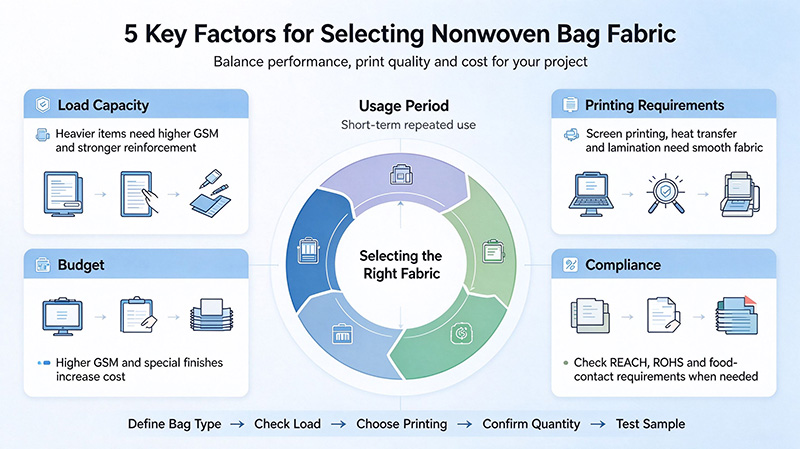
VI. Four-Step Quick Selection Guide
1. Determine the Bag Type: Identify whether it is a tote bag, drawstring bag, or promotional bag to establish the basic direction.
2. Determine Load Capacity: Select the appropriate fabric weight (GSM) based on the intended load.
3. Determine Finishing/Processing: Choose whether lamination or other post-processing techniques are required based on printing and texture specifications.
4. Sample Verification: Request samples to evaluate the tactile feel, print quality, and load-bearing capacity before placing a bulk order.
VII. Our Advantages in Bag-Making Fabrics
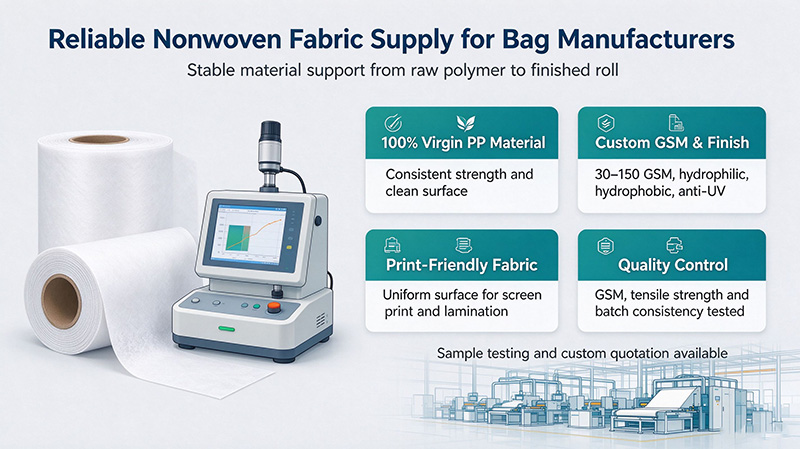
As a primary manufacturer specializing in PP spunbond non-woven fabrics, we provide reliable, high-quality materials for non-woven bag producers and packaging traders:
- Consistent Material Quality: Produced using 100% virgin PP resin, ensuring a uniform surface and stable tensile strength—no recycled materials or fillers.
- Comprehensive Specifications: Available in weights ranging from 30 to 150 GSM with customizable widths; various embossing patterns offered, including sesame-dot, circular-dot, and cross-hatch.
- Functional Customization: Supports specialized post-processing—such as hydrophilic, water-repellent, UV-resistant, anti-static, or flame-retardant treatments—to meet specific bag requirements.
- Print-Ready: Features a smooth surface with excellent ink adhesion, compatible with screen printing, thermal transfer, lamination, and other printing methods.
- Quality Assurance: Every batch undergoes rigorous testing for weight, tensile strength, and color consistency; test reports can be provided with each shipment.
- Reliable Delivery: Multiple production lines in operation ensure ample manufacturing capacity.
If you are sourcing fabrics for non-woven bags—or if you are unsure about the ideal weight or processing method for your project—please contact us. We can recommend the most suitable material solution based on your specific bag type, load requirements, printing needs, and budget, and provide samples for testing.
FAQ
Q1: What fabric weight (GSM) is typically recommended for non-woven bags?
A: The ideal weight depends on the type of bag: 30–60 GSM is generally used for promotional or giveaway bags; 50–80 GSM for drawstring bags (often used for footwear or apparel packaging); 70–100 GSM for standard shopping bags; and 100–120 GSM for gift bags requiring higher load-bearing capacity or for bags intended to carry heavier items like construction materials. The final choice should balance load-bearing requirements, budget, and the intended duration of use.
Q2: Is there a significant difference in practical use between non-woven bags made from virgin polypropylene (PP) and those made from recycled materials?
A: Yes, the difference is quite noticeable. For the same fabric weight, bags made from recycled materials are 20%–30% weaker; they are more prone to tearing and degradation (becoming brittle or powdery over time), often carry an unpleasant odor, and result in duller print colors. In contrast, bags made from virgin PP offer consistent strength, are odorless, provide superior print quality, and have a longer lifespan—making them ideal for brand packaging and repeated, long-term use.
Q3: Can non-woven shopping bags be made waterproof? What are the options?
A: Yes, they can. There are two main approaches: the first is a water-repellent treatment, a cost-effective option that protects against minor moisture or splashes. The second is lamination, which provides a higher level of water resistance, capable of withstanding rain for short periods. Additionally, the lamination process supports high-definition, full-color printing and offers a more premium look and feel, making it perfect for high-end gift bags and retail packaging.
Q4: What factors should be considered when selecting fabric for printed non-woven bags?
A: If you are only printing a simple, single-color logo, standard spunbond non-woven fabric is sufficient. If a design incorporates multi-color gradients or complex patterns, it is advisable to select fabrics with a smooth surface and fine embossing; this minimizes the impact of the fabric’s own texture on print quality. For high-definition, photo-quality color printing, laminated non-woven fabric is the best choice, as it ensures superior color accuracy and excellent ink adhesion.
Q5: How can issues such as fabric fraying (loose threads) or tearing at the drawstring opening be prevented in non-woven drawstring bags?
A: It is recommended to use calendered (smooth-surfaced) spunbond non-woven fabric. Avoid materials with raised bonding points or a coarse texture, as these are more prone to snagging. The fabric should have a basis weight of at least 50 GSM (grams per square meter), and the drawstring openings should be reinforced—for example, by adding metal eyelets or using heat-sealed edges. For high-end products, consider using hydroentangled (spunlace) non-woven fabric, which offers a finer, softer texture and a lower risk of snagging.
Q6: Is it advisable to simply choose a lower-basis-weight fabric to reduce procurement costs?
A: It is not recommended to blindly reduce the fabric's basis weight. Fabric that is too light lacks sufficient load-bearing capacity and is prone to tearing; this not only leads to higher product loss but can also negatively impact your brand's reputation. A wiser approach is to select the lowest possible basis weight that still meets your minimum load-bearing requirements, while simultaneously controlling costs by optimizing the bag's dimensions and simplifying the printing process.
Por favor, sigan leyendo, manténganse informados, suscríbanse y les invitamos a compartir sus opiniones.
Derechos de autor
@ 2026 Xinhua Textile Co., Limited Reservados todos los derechos
. RED SOPORTADA
Hi! Click one of our members below to chat on
 Español
 English
 Français
 Deutsch
 Русский
 Italiano
 Português
 عربي
 Indonesia
 עִברִית


